

Fish peptones market seen reaching $2.3B by 2033
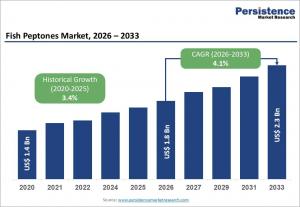
Persistence Market Research projects the global fish peptones market will rise from $1.8 billion in 2026 to $2.3 billion by 2033, driven by biotechnology research, biopharmaceutical production and fermentation demand. Asia Pacific led the market in 2025, while supply volatility and raw-material consistency remain key constraints.
Why it matters: - Fish peptones are used as culture media ingredients in microbiology, biotechnology and pharmaceutical production. - The market’s growth points to rising demand for fermentation nutrients, biologics inputs and quality-controlled lab materials across developed and emerging economies. - Expansion in biopharma manufacturing and research spending is widening the customer base for premium peptone products.
What happened: - Persistence Market Research projects the global fish peptones market will grow from US$ 1.8 billion in 2026 to US$ 2.3 billion by 2033. - The forecast implies a 4.1% compound annual growth rate from 2026 through 2033. - The market is being supported by biotechnology research, biopharmaceutical production, fermentation applications and demand for high-quality culture media. - Asia Pacific held the largest regional share in 2025 at 38.1% of global revenue.
The details: - Fish peptones provide organic nitrogen, peptides and growth factors for microbial fermentation and cell culture systems. - The products are used in recombinant protein, antibiotic, vaccine and other biologics production. - Key applications include microbial culture media, pharmaceuticals and vaccines, nutraceuticals and functional foods, veterinary and animal health bioproduction, and cosmetics and personal care. - Product formats include enzymatic hydrolysis peptones, acid hydrolysis peptones and autolysates. - Sales channels include direct B2B sales, distributors and online platforms. - Asia Pacific’s lead is tied to expanding biotechnology industries, growing pharmaceutical production and strong availability of seafood processing byproducts. - China, India and Japan are strengthening research capabilities and biomanufacturing infrastructure. - Europe remains a major market because of advanced biotechnology ecosystems and fermentation industries. - North America is growing on the back of high research spending, established pharmaceutical companies and rising demand for culture media used in biologics production. - The competitive field includes Kerry Group, Titan Biotech Ltd, Hardy Diagnostics, HiMedia Laboratories, Solabia Group, Copalis, BioSpringer, Biotecnica, Bioiberica and Biolink Group. - Companies are investing in tailored formulations, more production capacity and broader distribution networks. - Sustainability efforts are increasingly focused on using more marine byproducts and reducing environmental impact.
Between the lines: - The market’s growth is tied to a broader shift toward higher-specification inputs in bioprocessing. - Fish-derived peptones face a practical constraint: raw material supply can fluctuate with seasonal fishing patterns, environmental conditions, regulatory quotas and seafood demand. - Variation in seafood processing byproducts can also affect amino acid profiles and product performance, which raises production complexity. - Manufacturers that can improve consistency, purity and regulatory compliance may capture more value as customers seek customized media formulations. - In October 2025, a scientific study found that converting fish head waste into nitrogen-rich peptone ingredients can produce lower greenhouse gas emissions than conventional plant or dairy alternatives.
What’s next: - Demand is expected to keep rising as biologics, vaccines, diagnostics and industrial enzyme production expand. - Advances in enzymatic hydrolysis, fractionation and purification are likely to support more specialized and higher-purity formulations. - Contract development and manufacturing organizations should continue to push demand for application-specific solutions. - Sustainability claims around marine byproduct use may become a bigger differentiator as buyers weigh supply resilience and environmental impact.
The bottom line: - Fish peptones are moving from a niche ingredient to a more strategic bioprocessing input, with growth driven by biopharma scale-up and innovation in culture media.
Disclaimer: This article was produced by AGP Wire with the assistance of artificial intelligence based on original source content and has been refined to improve clarity, structure, and readability. This content is provided on an “as is” basis. While care has been taken in its preparation, it may contain inaccuracies or omissions, and readers should consult the original source and independently verify key information where appropriate. This content is for informational purposes only and does not constitute legal, financial, investment, or other professional advice.
Sign up for:
Aquaculture World Today
The daily local news briefing you can trust. Every day. Subscribe now.
Check Your Email!
We sent a one-time activation link to: .
Confirm it's you by clicking the email link.
If the email is not in your inbox, check spam or try again.
Welcome back!
is already signed up. Check your inbox for updates.