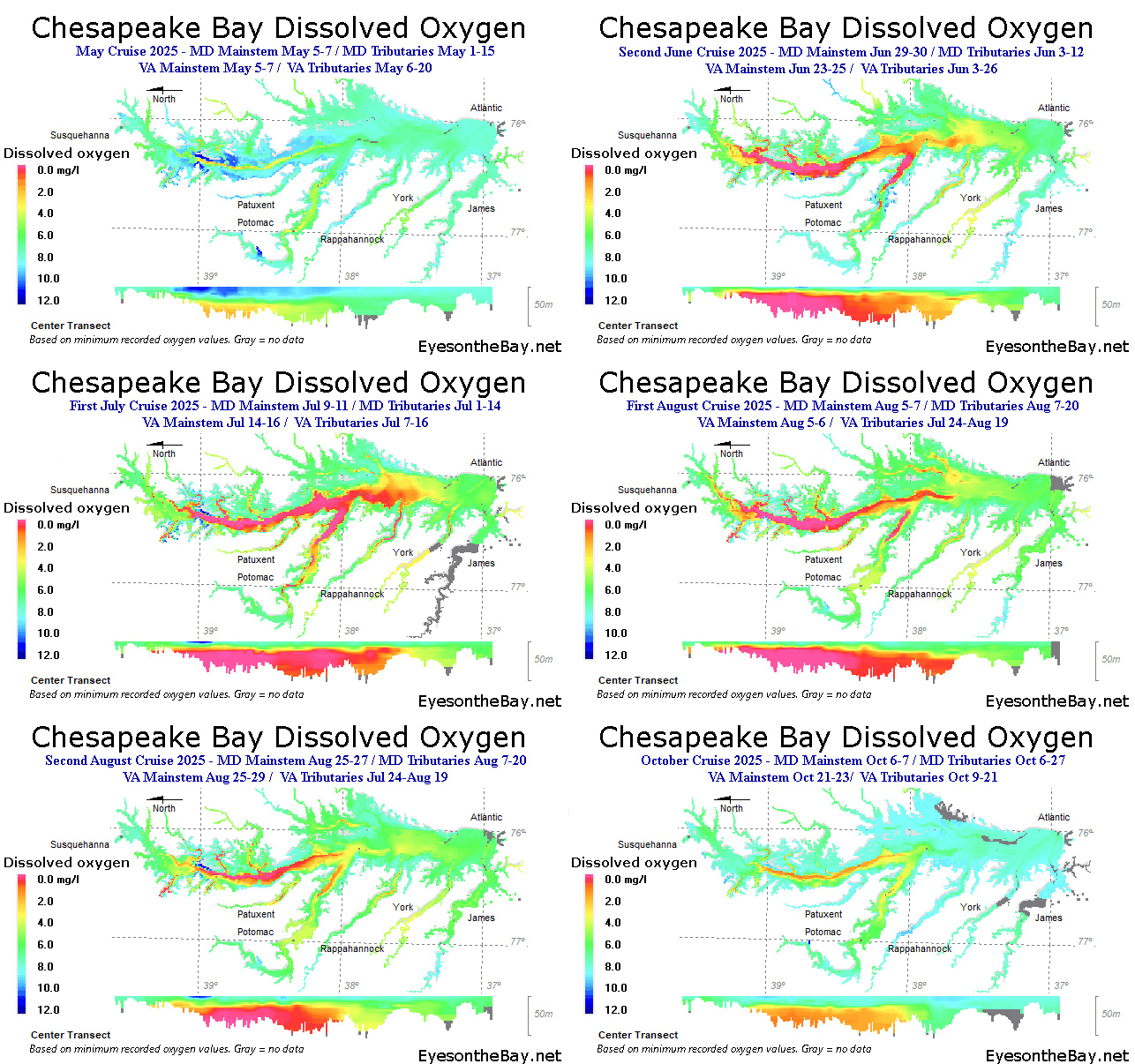

 Data collected by the Maryland Department of Natural Resources and Old Dominion University showed that 2025 seasonal hypoxia—waters with less than 2 mg/l of oxygen—was slightly above average in the Chesapeake Bay mainstem of Maryland and Virginia.
Hypoxia was below average in May and early June, then higher than average in late June through early August, before returning to below average in late August and September. Hypoxia was likely underestimated in September due to a number of unsampled stations in Maryland’s lower Bay. October hypoxia volumes were low but above average for the month, perhaps due to sampling occurring in the first week of October, which is earlier than normal. On average, the 2025 seasonal volume was the 11th largest out of 41 years assessed.
Summary results from combined Maryland and Virginia mainstem Bay monitoring cruises are as follows, with volumes in cubic miles. Rank is in order of lowest (better conditions) to highest hypoxia volume (worse conditions) versus years analyzed.
|
2025 Cruise |
Hypoxic Volume |
Average Volume (1985-2024) |
2025 Rank |
Graphic |
|
May |
0.0 |
0.19 |
1st (tied) / 41 |
|
|
Early June |
0.68 |
0.85 |
13th / 37 |
|
|
Late June |
1.76 |
1.25 |
26th / 35 |
|
|
Early July |
2.29 |
1.59 |
35th / 40 |
|
|
Late July |
1.74 |
1.62 |
24th / 40 |
|
|
Early August |
1.85 |
1.29 |
29th / 38 |
|
|
Late August |
0.89 |
1.06 |
18th / 41 |
|
|
September |
0.21 |
0.45 |
10th / 41 |
|
|
October |
0.22 |
0.08 |
34th / 39 |
|
|
Year End Average |
1.28 |
0.94 |
31st / 41 |
Qualitatively, freshwater flows into the Chesapeake Bay leading up to summer were about 20% above average, indicating a greater than average hypoxic volume may be observed during this season due to more nutrients entering the Bay.
Above average volumes in late June and into July could be the result of significant rainfall in Maryland and Pennsylvania during May, and high average air temperatures in the region during June and July, with nutrients from runoff fueling algal blooms, their decomposition, and resultant oxygen consumption.
The summer of 2025 has presented a number of meteorological extremes for the region. According to NOAA’s National Centers for Environmental Information, Maryland received 7.81 inches of rainfall in May, the highest in the past 131 years. Pennsylvania’s precipitation was 7.72 inches, the second highest in that same time frame. This year’s rainy May was followed by a hot June and July. Maryland’s average temperatures in June was 74.8 degrees, fourth-highest in 131 years, and 79.9 degrees in July, second-highest in 131 years. The weather extremes changed from hot to cooler in August, with Maryland’s average August temperatures the 25th lowest since 1895 at 71.8 degrees. Average temperatures this low had not been observed since 2004 and 1994. Precipitation in August was the third and seventh lowest in Pennsylvania and Maryland respectively. Due to the federal government shutdown, monthly meteorological summaries from NOAA are not yet available past August 2025.
Crabs, fish, oysters, and other creatures in the Chesapeake Bay require dissolved oxygen to survive. Scientists and natural resource managers study the volume and duration of Bay hypoxia to determine possible impacts to Bay life.
Ongoing efforts to reduce nitrogen and phosphorus pollution from industrial and wastewater sources, agricultural land, and cities and towns are aimed at reducing hypoxic conditions in the Bay. In the water, nitrogen and phosphorus fuel algal blooms that remove oxygen from the water when they die off and decompose.
Each year from May through October, the Department of Natural Resources computes hypoxia volumes from the water quality data managed by department staff and the Virginia Department of Environmental Quality. Data collection is funded by these states and the EPA Chesapeake Bay Program.
Scientists at William and Mary’s Batten School and Virginia Institute of Marine Science, in collaboration with Anchor QEA, also released their 2025 Dead Zone Report Card, which compares hypoxic duration as well as total annual hypoxic volume for the year, including both the mainstem Bay and the tributaries.
Bay monitoring continues year round and hypoxia reporting will resume in May 2026.
Additional Maryland water quality data and information, including the Department of Natural Resources hypoxic volume calculation methods, can be found on the Eyes on the Bay website.