
Bringing you the latest news on agriculture
Provided by AGP
Global Fertilizer Market Size to Reach $248 Billion by 2034; Growing at 3.04% CAGR: New Analysis
Fertilizer Market Report 2026
IMARC Group's Latest Research Reveals a CAGR of 3.04% from 2026–2034, with Chemical Fertilizers and Dry Product Form Segments Leading Expansion
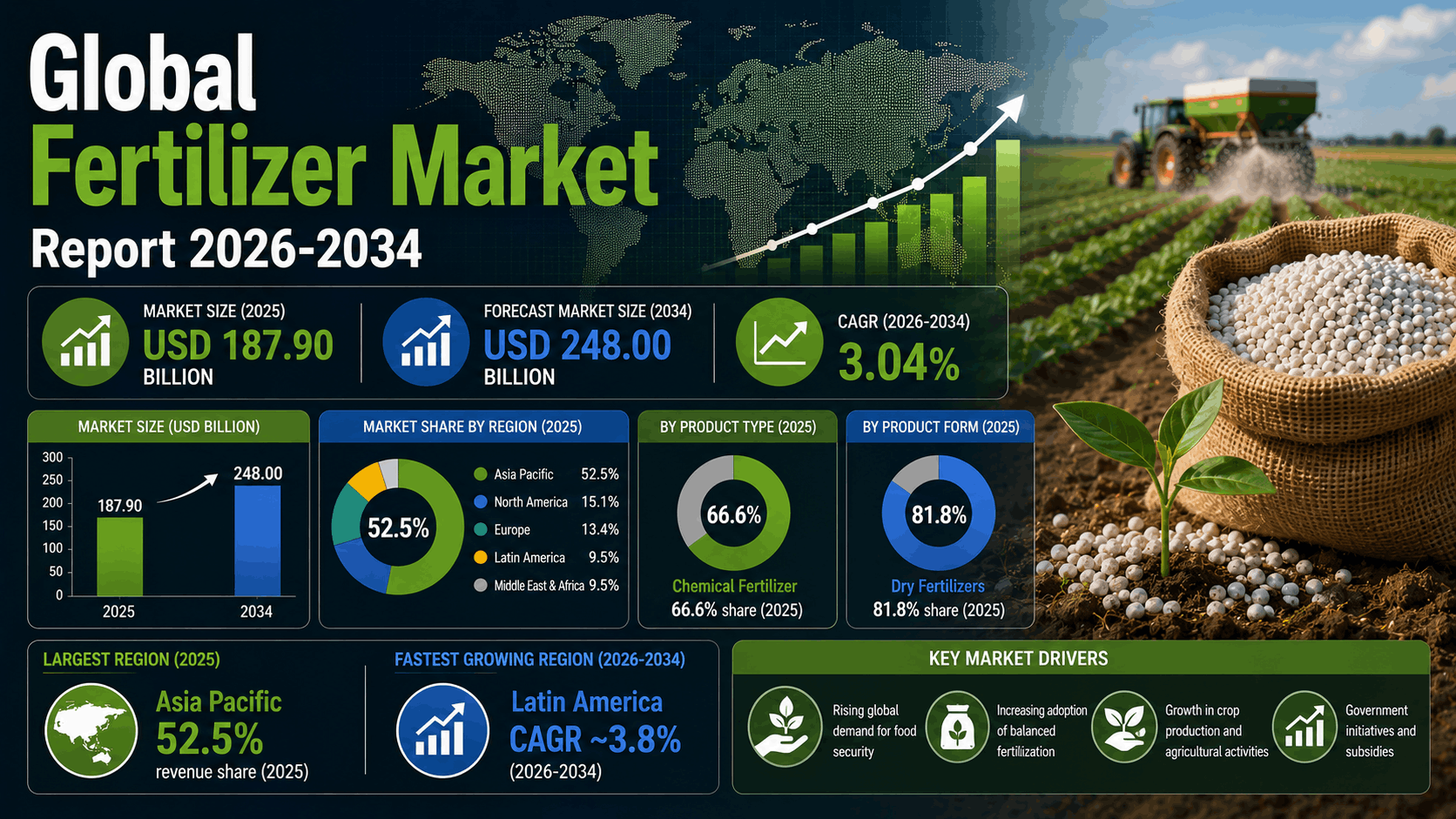
SHERIDAN, WY, UNITED STATES, May 7, 2026 /EINPresswire.com/ -- The global fertilizer market, valued at USD 187.90 Billion in 2025, is on a firm upward trajectory, projected to reach USD 248.00 Billion by 2034, expanding at a steady CAGR of 3.04% over the forecast period (2026–2034). This sustained growth is underpinned by escalating global food security imperatives, record-level government subsidy programs, and the expanding integration of precision agriculture technologies across the world's most productive farming regions. With an absolute value addition of USD 60.1 Billion over nine years, the fertilizer market represents one of the most structurally anchored investment opportunities in the global agricultural inputs sector.The scale of the opportunity is starkest when viewed through the lens of demographic necessity. The world must feed approximately 9.7 Billion people by 2050, requiring global food production to rise by an estimated 50–60% from 2019 levels. Annual cereal production alone must climb to roughly 3 Billion tonnes by 2050 from 2.1 Billion today - a target that is impossible to achieve without sustained intensification of fertilizer application rates across staple crop farming systems worldwide. Compounding this pressure, total cropland area per person has already declined by approximately 20% between 2001 and 2023, making yield intensification through fertilization the primary lever for meeting humanity's food production requirements.
Request for a sample to get detailed understanding about the market: https://www.imarcgroup.com/fertilizer-market/requestsample
What is Driving the Fertilizer Market's Boom?
• Rising Global Food Demand: With the global population forecast to grow by 1.5 Billion people by 2050, agricultural systems face an unprecedented production mandate. Annual cereal output must rise from 2.1 Billion tonnes to approximately 3 Billion tonnes, creating an indispensable structural demand floor for nitrogen, phosphate, and potash fertilizers. The irreplaceable role of nitrogen in protein synthesis for cereal crops ensures that urea, ammonium nitrate, and DAP will remain critical agricultural inputs for decades, with global urea demand already exceeding 185.7 million metric tons in 2025 - a milestone that underscores the scale of this structural driver.
• Government Subsidy and Food Security Programs: Government interventions across the three largest consuming nations - India, China, and Brazil - collectively sustain demand at artificially elevated levels that private market economics alone could not support. India's fertilizer subsidy program allocated INR 1.64 lakh crore in FY2025, sustaining urea retail prices approximately 80% below market rates for farmers. Brazil's zero import tariff policy on fertilizers has enabled a surge in agricultural imports, with Brazil — the world's largest fertilizer importer - importing approximately 45.5 million metric tons in 2025. China's agricultural input support programs similarly maintain high application rates in one of the world's most intensive grain-producing economies.
• Precision Agriculture and Variable-Rate Technology: Digital farming technologies are fundamentally reshaping how fertilizers are applied, optimizing placement and timing to maximize yield while maintaining or growing total fertilizer expenditure per farm. Satellite AI mapping now detects nutrient stress with 92% accuracy, and variable-rate fertilization technology guided by these systems was deployed across 12 million hectares globally by 2025. This technology-driven precision does not reduce fertilizer market volumes — rather, it shifts demand toward higher-efficiency, premium-priced formulations including controlled-release products, liquid fertigation inputs, and nano fertilizers that command significant price premiums over conventional commodity grades.
Key Market Insights at a Glance
The following highlights the leading segments by category based on 2025 market share data:
• Product Type — Chemical Fertilizer: 66.6% market share, anchored by nitrogenous fertilizers essential for global cereal crop cultivation
• Product Form — Dry Fertilizers: 81.8% market share, reflecting the logistical and handling advantages of granular urea, DAP, and MOP for large-scale mechanized farming
• Region — Asia Pacific: 52.5% market share, driven by massive rice and wheat cultivation programs in China and India backed by government-subsidized distribution systems
• Fastest Growing Region — Latin America: ~3.8% CAGR (2026–2034), propelled by Brazil's soybean, sugarcane, and corn expansion and zero import tariff policies on fertilizers
• Fastest Growing Product Type — Biofertilizers: ~4.8% CAGR (2026–2034), driven by the EU's Farm to Fork Strategy, India's promotion of natural farming, and growing organic agriculture premiums globally
Detailed Segment Analysis
By Product Type: Chemical Fertilizer Dominates with 66.6% Share
Chemical fertilizers command 66.6% of the global fertilizer market in 2025, representing approximately USD 125.1 Billion in annual revenues. This segment's dominance is structurally non-negotiable: nitrogen, phosphorus, and potassium are irreplaceable macronutrients for plant growth, and no biological or organic alternative can match the scale, consistency, and cost-efficiency of synthetic fertilizer supply for large-scale commodity grain production. The segment spans nitrogenous fertilizers (urea, ammonium nitrate, calcium ammonium nitrate, ammonium sulfate, anhydrous ammonia), phosphatic fertilizers (MAP, DAP, SSP, TSP), potash fertilizers (MOP and SOP), secondary macronutrient fertilizers, and complex fertilizers — each with distinct demand profiles across crop systems and geographies.
India's chemical fertilizer consumption alone reached 62.98 million tonnes in 2020–21 (excluding SSP), representing an 82.5% increase from 2000 to 2001 — a trajectory that illustrates the structural growth dynamic underpinning this segment across developing Asia. In April 2025, CF Industries Holdings formed a joint venture with JERA Co., Inc. and Mitsui & Co., Ltd. for the construction, production, and offtake of low-carbon ammonia, signaling the industry's recognition that decarbonizing nitrogen production is both a regulatory imperative and a commercial opportunity. Meanwhile, in November 2023, CoteX Technologies and Nutrien entered into a Memorandum of Understanding (MOU) to jointly commercialize a coating technology designed to produce an affordable, environmentally-friendly nitrogen fertilizer for large acreage crops in the North American market.
Connect for detailed segmentation analysis, ask for analyst: https://www.imarcgroup.com/request?type=report&id=2503&flag=C
By Product Form: Dry Fertilizers Lead at 81.8%
Dry fertilizers — encompassing granular and prilled forms including granular urea, DAP, and MOP — account for 81.8% of global fertilizer market demand in 2025, representing approximately USD 153.7 Billion in market value. The dominance of this form factor is rooted in practical agricultural logistics: granular and prilled products offer superior stability, extended shelf life, ease of bulk handling, and full compatibility with mechanized broadcast and banded application equipment used across large-scale commercial farming operations from the U.S. corn belt to the Indo-Gangetic Plains. The physical properties of dry fertilizers — flowability, dust suppression, and resistance to caking — are critical quality parameters for distribution chains that span ocean freight, rail, truck, and last-mile dealer networks across 160+ countries.
Liquid fertilizers hold the remaining 18.2% market share (2025), with the segment growing at a faster CAGR of approximately 4.2% through 2034. Liquid urea ammonium nitrate (UAN) solution and liquid phosphoric acid are the primary liquid forms, predominantly used in North American corn and wheat production through high-efficiency subsurface injection application systems. Liquid fertilizers provide superior nutrient uniformity, homogeneous distribution through center-pivot and drip irrigation systems (fertigation), and compatibility with precision application technologies — advantages that are driving share gains particularly in high-value horticultural and specialty crop systems where uniform nutrient delivery directly translates to premium-grade produce yields.
By Crop Type: Grains and Cereals Commands Dominant Share
Grains and cereals constitute the largest crop type segment within the global fertilizer market, a position that directly reflects the primacy of rice, wheat, and maize in global food systems. These three crops account for the majority of global caloric intake, and their production systems are the most fertilizer-intensive in agriculture — nitrogen application rates for intensive rice paddies in Asia and maize cultivation in North America represent the largest single source of fertilizer demand globally. The structural growth in cereals consumption, driven by population expansion and rising incomes in developing economies that increase per-capita calorie and protein consumption, creates a durable demand foundation for nitrogenous and phosphatic fertilizer application across this segment.
Pulses and oilseeds, fruits and vegetables, and flowers and ornamentals round out the crop type segmentation. The oilseeds segment — particularly soybeans in Brazil, Argentina, and the U.S. — is among the fastest-growing subsegments, as Brazil's agribusiness expansion drives fertilizer demand growth across the world's most dynamic agricultural frontier. Fruits and vegetables command premium fertilizer expenditure per hectare due to the agronomic requirement for precision nutrient management in high-value crop production systems, making this subsegment particularly receptive to controlled-release fertilizers, water-soluble specialty formulations, and biostimulant co-formulations. [Specific crop type market share percentages were not available on the source page.]
By Biofertilizer Segment: Fastest Growing at ~4.8% CAGR
While biofertilizers currently hold 33.4% of the product type market (2025), they represent the market's highest-growth investment opportunity at approximately 4.8% CAGR through 2034, significantly outpacing the overall market's 3.04% growth rate. The segment's acceleration is driven by converging regulatory, consumer, and agronomic forces: the EU's Farm to Fork Strategy is systematically restricting synthetic nitrogen use, India's National Mission on Natural Farming is incentivizing biological inputs at the farmer level, and premium-priced export markets for certified organic and regenerative produce are creating commercial pull for biological alternatives to conventional fertilizers.
Key sub-segments within the biofertilizer and high-growth product tiers include:
• Nano Fertilizers (Fastest Disrupting): IFFCO's Nano Urea (launched 2021) requires only 500 ml per acre, with cumulative sales of 10.68 crore bottles (500 ml each) of Nano Urea and 2.75 crore bottles of Nano DAP since inception across all regions of India — demonstrating both the agronomic credibility and commercial scalability of nano-delivery platforms.
• Controlled-Release Fertilizers (CRF) (~6.8% CAGR): Polymer-coated urea (PCU) and sulfur-coated urea (SCU) match nitrogen release to crop uptake curves, dramatically reducing leaching losses; polymer-coated urea for rice uses 60–120 day controlled release formulations.
• Liquid Fertilizers for Fertigation (~4.2% CAGR): Adoption in high-value horticulture and intensive vegetable systems is accelerating as drip irrigation penetration expands across emerging markets.
• Green and Blue Ammonia: Being commercialized by Yara, CF Industries, and SABIC as pathways to decarbonize nitrogen fertilizer production — Yara's Porsgrunn plant already produces 20,500 tons of green ammonia annually.
Regional Spotlight: Where Is the Action?
Asia Pacific's commanding 52.5% revenue share (2025) makes it the unambiguous center of gravity for the global fertilizer market, anchored by the agricultural intensity of China, India, Indonesia, and Bangladesh in rice, wheat, palm oil, and jute production. India's fertilizer production reached 509.57 lakh tonnes in 2024 and accelerated to an all-time high of 524.62 lakh tonnes in 2025, while India's government-subsidized distribution system sustains urea prices 80% below market rates for farmers — structural supports that ensure demand durability regardless of global commodity price cycles.
• Nano Fertilizers (Fastest Disrupting): IFFCO's Nano Urea (launched 2021) requires only 500 ml per acre, with cumulative sales of 10.68 crore bottles (500 ml each) of Nano Urea and 2.75 crore bottles of Nano DAP since inception across all regions of India — demonstrating both the agronomic credibility and commercial scalability of nano-delivery platforms.
• Controlled-Release Fertilizers (CRF) (~6.8% CAGR): Polymer-coated urea (PCU) and sulfur-coated urea (SCU) match nitrogen release to crop uptake curves, dramatically reducing leaching losses; polymer-coated urea for rice uses 60–120 day controlled release formulations.
• Liquid Fertilizers for Fertigation (~4.2% CAGR): Adoption in high-value horticulture and intensive vegetable systems is accelerating as drip irrigation penetration expands across emerging markets.
• Green and Blue Ammonia: Being commercialized by Yara, CF Industries, and SABIC as pathways to decarbonize nitrogen fertilizer production - Yara's Porsgrunn plant already produces 20,500 tons of green ammonia annually.
Technology Is Redefining Agricultural Nutrition Operations
The fertilizer industry's technological transformation is advancing on four simultaneous fronts, each reshaping cost structures, environmental performance, and competitive dynamics in ways that will define market leadership through 2034. The Haber-Bosch process, which has produced synthetic nitrogen for over a century, is now being challenged at the frontier by electrochemical nitrogen fixation and green ammonia synthesis. Yara International and CF Industries have both made substantial investments in green and blue ammonia projects — with Yara's Porsgrunn facility producing 20,500 tons of green ammonia annually — while CF Industries' April 2025 joint venture with JERA Co. and Mitsui & Co. for low-carbon ammonia production marks the industry's clearest signal yet that decarbonization is no longer aspirational, but commercially underway.
Nanotechnology is delivering perhaps the most disruptive near-term innovation. IFFCO's Nano Urea contains 4% nitrogen in nanoparticle form, enabling dramatically more efficient delivery per unit of nitrogen applied. Carbon nanotube-based micronutrient carriers and nano-zeolite nitrogen carriers are currently in commercial pilot phase with multiple global producers. Parallel advances in polymer-coated urea (PCU) and sulfur-coated urea (SCU) — using 60–120 day controlled release formulations for rice — are reducing nitrogen leaching losses while qualifying farmers for premium-priced sustainable agriculture supply chain certification programs.
Digital agriculture platforms are the third transformation vector reshaping the industry. Satellite multispectral imaging, IoT soil moisture and EC sensors, and AI-driven crop modeling platforms now enable real-time, field-level fertilizer rate recommendations at scale. These precision platforms simultaneously reduce over-fertilization, cut farmer input costs, and generate the traceability data needed for carbon-credit-linked fertilizer programs that are gaining commercial traction in North America and the EU.
Request Customization: https://www.imarcgroup.com/request?type=report&id=2503&flag=E
Challenges the Industry Must Address
• Raw Material Price Volatility: Natural gas costs represent 70–80% of the cost price of gray ammonia, the primary feedstock for nitrogenous fertilizer production globally. This extreme energy cost dependency creates structural margin volatility for nitrogen fertilizer producers and creates price transmission uncertainty for farmers making seasonal input purchase decisions. Geopolitical disruptions - such as the European natural gas price surge following the Russia-Ukraine conflict - can compress margins and disrupt supply chains across the entire nitrogen fertilizer value chain simultaneously, creating affordability crises in import-dependent developing markets.
• Stringent Environmental Regulations on Nitrogen Application: The EU Nitrates Directive restricts nitrogen application rates to 170 kg N/ha in vulnerable zones, affecting a significant portion of EU agricultural land and structurally capping demand growth in one of the world's most important fertilizer-consuming regions. As regulatory scrutiny on fertilizer-driven water quality impacts intensifies globally, similar regulatory frameworks are being developed in China, India, and the U.S. - markets that collectively account for the majority of global nitrogen fertilizer consumption - creating potential headwinds for volume growth in the world's largest demand centers.
About IMARC Group
IMARC Group is a leading global market research company providing data-driven insights and expert consulting services to businesses seeking to achieve their strategic objectives. With a multi-disciplinary team of industry experts, IMARC delivers thorough, reliable market intelligence across sectors including Agriculture and Agri-Inputs, Chemicals and Materials, Food and Beverages, Energy and Mining, and Healthcare. The firm's research methodology combines primary interviews with over 170 industry stakeholders, secondary analysis of 310+ sources, and hybrid bottom-up and top-down forecasting models to deliver commercially actionable intelligence for the world's most demanding investors and business strategists.
Elena Anderson
IMARC Services Private Limited
+1 201-971-6302
email us here
Legal Disclaimer:
EIN Presswire provides this news content "as is" without warranty of any kind. We do not accept any responsibility or liability for the accuracy, content, images, videos, licenses, completeness, legality, or reliability of the information contained in this article. If you have any complaints or copyright issues related to this article, kindly contact the author above.
