

Farming with fish: a natural boost for soil phosphorus
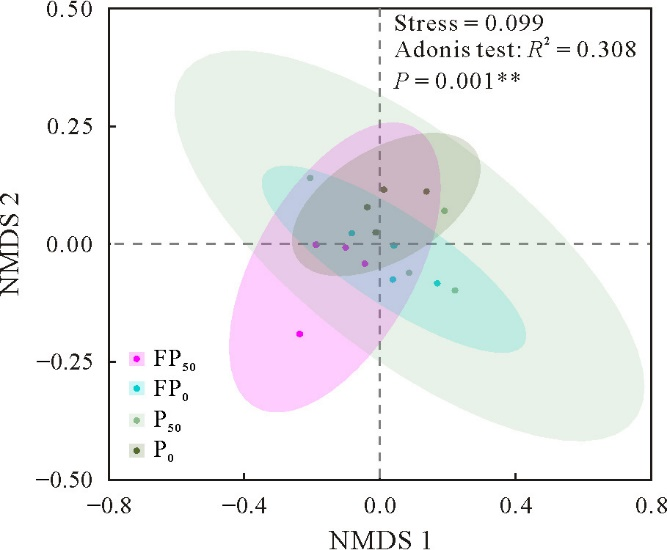
Plot of nonmetric multidimensional scaling ordination (NMDS) analysis, based on the Bray-Curtis distance matrix, for phoD-harboring bacterial community composition under rice-fish coculture combined with and without P addition.
GA, UNITED STATES, May 25, 2026 /EINPresswire.com/ -- A new study highlights the surprising potential of rice-fish coculture (RFC) to naturally increase phosphorus (P) availability in paddy soils—without the need for added fertilizers. By introducing fish into flooded rice paddies, researchers observed a significant increase in soil phosphatase activity and a shift in microbial communities responsible for organic P mineralization. These biological changes enabled the transformation of less-accessible P into forms usable by plants. The findings suggest that RFC can serve as a sustainable, low-input solution for enhancing soil fertility by harnessing the ecological functions of key soil bacteria, offering a promising pathway toward resource-efficient farming.
Phosphorus (P) is essential for plant growth, yet it often exists in forms unavailable to crops, particularly in acidic, flooded paddy soils common to tropical regions. Conventional farming practices rely on mineral fertilizers to compensate for this deficiency, leading to environmental risks and high production costs. rice-fish coculture (RFC), an ancient agroecological practice where fish and rice grow together, has long been praised for its resource efficiency and biodiversity benefits. However, its effects on soil P cycling and microbial dynamics remain poorly understood. Due to these challenges, there is a growing need to explore whether RFC can stimulate microbial activity and enhance P turnover naturally—without chemical input.
A team from South China Agricultural University has uncovered new evidence that RFC can improve soil nutrient cycling—particularly P—without relying on fertilizers. Their study (DOI: 10.1016/j.pedsph.2024.06.002), published in Pedosphere in June 2025, reveals that introducing fish into rice paddies enhances the composition and function of phoD-harboring bacteria, which are known to facilitate P mineralization. Using a controlled microcosm experiment, the researchers demonstrated that RFC significantly boosts available P levels by transforming moderately labile P into more accessible forms.
The researchers designed four treatment systems: rice monoculture and RFC, each with and without P addition. Notably, the fish-inclusive system without added P (FP0) significantly increased soil P availability and enzyme activity compared to conventional monoculture. The presence of fish enhanced phosphatase activity, altered soil pH, and promoted microbial biomass turnover, collectively facilitating the breakdown of organic P into plant-available forms.
Crucially, RFC influenced the abundance and diversity of phoD-harboring bacteria—microbes that encode alkaline phosphatases vital for P cycling. Keystone genera such as Vibrio and Geomonas showed strong associations with soil P dynamics, contributing to the transformation of P fractions.
Structural equation modeling revealed that labile P content was primarily influenced by moderately labile P and microbial processes rather than external fertilizer input. This means that fish activity—via bioturbation and nutrient-rich excreta—stimulated beneficial microbial shifts and nutrient mobilization, enhancing P bioavailability in a natural and sustainable way. These findings support the hypothesis that RFC can serve as a microbial bridge for unlocking soil-bound P.
“Our findings show that RFC is not just a traditional practice—it’s a modern, eco-friendly strategy to enrich soil nutrients,” said Prof. Jiaen Zhang, corresponding author of the study. “By stimulating key microbial communities and enzymatic functions, fish presence in paddy fields naturally enhances P availability. This opens new opportunities to reduce fertilizer dependency while supporting crop productivity, particularly in P-deficient regions.”
This study offers compelling evidence for promoting RFC as a sustainable alternative to P-based fertilizers. Farmers could reduce production costs and environmental pollution by leveraging biological P cycling rather than chemical amendments. The microbial insights also suggest future avenues for optimizing soil management through bio-stimulation of phoD-harboring bacteria. Given its ecological and economic benefits, RFC can serve as a model system for climate-resilient agriculture in Asia and beyond—especially in areas facing P scarcity, fertilizer overuse, or ecological degradation. Scaling up this nature-based approach could help achieve global goals for sustainable food production and nutrient efficiency.
DOI
10.1016/j.pedsph.2024.06.002
Original Source URL
https://doi.org/10.1016/j.pedsph.2024.06.002
Funding information
This research was supported by the Key-Area Research and Development Program of Guangdong Province, China (No. 2021B0202030002), the Science and Technology Planning Project of Guangdong Province, China (No. 2019B030301007), the Guangdong Provincial Special Project of Rural Revitalization Strategy, China (No. (2021)12), the Joint Team Project of Guangdong Laboratory for Lingnan Modern Agriculture, China (No. NT2021010), and the Innovation Team Construction Project of Modern Agricultural Industry Technology Systems of Guangdong Province, China (No. 2022KJ105).
Lucy Wang
BioDesign Research
email us here
Legal Disclaimer:
EIN Presswire provides this news content "as is" without warranty of any kind. We do not accept any responsibility or liability for the accuracy, content, images, videos, licenses, completeness, legality, or reliability of the information contained in this article. If you have any complaints or copyright issues related to this article, kindly contact the author above.
