

Marine Electronics Market to Reach US$ 13.36 Billion by 2035 with Smart Maritime Adoption
Marine Electronics Market
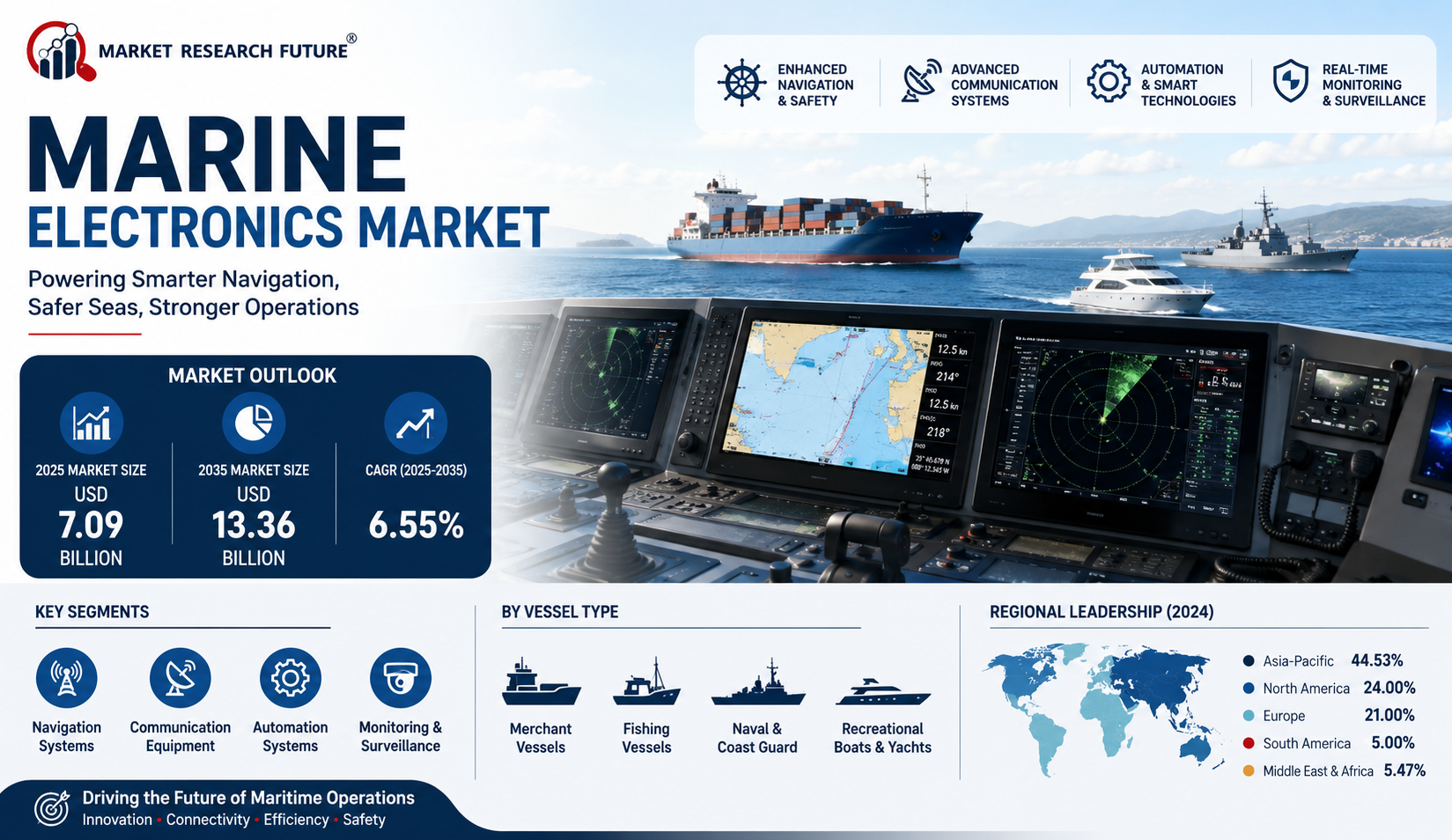
The Market is projected to grow from USD 7.09 Billion in 2025 to USD 13.36 Billion by 2035, registering a CAGR of 6.55% during the forecast period (2025–2035).
NEW YORK, NY, UNITED STATES, July 22, 2026 /EINPresswire.com/ -- The Marine Electronics Market is undergoing a steady transformation, supported by advancements in navigation, communication, automation, and onboard monitoring technologies. The industry is evolving as maritime stakeholders prioritize operational safety, regulatory compliance, and digital integration across vessels. The increasing adoption of smart maritime systems, coupled with regulatory mandates and rising investments in fleet modernization, is strengthening market expansion.Growth is supported by the integration of AI-enabled analytics, satellite communication technologies, and automation systems across commercial and defense marine operations.
Latest Market Trends:
1. Shift Toward Integrated Bridge Systems - Marine operators are increasingly adopting integrated bridge systems that combine navigation, communication, and monitoring functions into a single interface. These systems enhance situational awareness and reduce human error while improving operational efficiency.
Request Sample of Report: https://www.marketresearchfuture.com/sample_request/6881
2. Adoption of LEO Satellite Connectivity - Low Earth Orbit (LEO) satellite communication is emerging as a transformative trend, enabling high-speed and low-latency connectivity at sea. This advancement supports real-time data transmission, remote diagnostics, and seamless communication between vessels and shore.
3. Growth of Autonomous and Remote-Operated Vessels - The development of autonomous vessels is accelerating, particularly in Asia-Pacific and Europe. These vessels rely heavily on advanced sensors, radar systems, and AI-powered navigation solutions, increasing demand for high-performance marine electronics.
4. Digitalization of Fishing and Commercial Fleets - Fishing and merchant fleets are adopting digital technologies such as sonar-based fish detection, predictive analytics, and automated navigation tools. This trend is enhancing catch efficiency and reducing operational costs.
5. Smart Port Integration - The integration of marine electronics with smart port infrastructure is enabling improved logistics, vessel tracking, and port management. Shore-to-ship connectivity systems are becoming essential for efficient maritime operations.
Key Market Drivers:
1. IMO e-Navigation & SOLAS Retrofit Mandates (~22% Impact) - Global regulatory frameworks are driving the adoption of advanced navigation and safety systems. Compliance requirements are pushing shipowners to upgrade legacy systems, resulting in increased demand for marine electronics.
2. Autonomous Vessel Programs (~18% Impact) - The development of autonomous and semi-autonomous vessels is creating demand for advanced radar, communication, and AI-driven navigation systems, particularly in Asia-Pacific and Europe.
3. Insurance-Linked Situational Awareness (~14% Impact) - Insurance companies are increasingly evaluating vessels based on onboard safety technologies. This is encouraging operators to install advanced monitoring and surveillance systems.
4. Smart Port Connectivity (~13% Impact) - Investments in smart ports and digital infrastructure are supporting the adoption of marine electronics that enable real-time communication and operational efficiency.
5. LEO Satellite Broadband (~12% Impact) - Improved connectivity solutions are enhancing vessel communication capabilities, enabling remote monitoring and predictive maintenance.
6. Recreational Boating Premiumization (~11% Impact) - Demand for luxury yachts and recreational boats equipped with advanced navigation and entertainment systems is rising, particularly in North America and Europe.
7. Arctic Route Expansion (~10% Impact) - The opening of new shipping routes in Arctic regions is increasing the need for specialized navigation and monitoring equipment designed for extreme conditions.
Key Opportunities:
1. Predictive-Maintenance Analytics Platforms
The adoption of predictive-maintenance solutions is creating significant opportunities in the marine electronics market. Advanced analytics platforms, powered by AI and IoT-enabled sensors, allow real-time monitoring of vessel systems such as engines, navigation equipment, and onboard electronics. These systems help detect potential failures before they occur, reducing unplanned downtime and maintenance costs. Shipping companies are increasingly investing in such platforms to improve operational efficiency, extend equipment lifespan, and ensure compliance with safety standards. This trend is particularly valuable for large commercial fleets where even minor disruptions can result in substantial financial losses.
2. Emerging-Market Fleet Modernization
Developing regions are actively upgrading their aging maritime fleets, presenting strong growth opportunities for marine electronics providers. Countries across Asia-Pacific, South America, and parts of Africa are investing in modern vessels equipped with advanced navigation, communication, and automation systems. Government initiatives to improve maritime infrastructure, enhance trade efficiency, and strengthen coastal security are accelerating this transition. As older vessels undergo retrofitting to meet international regulations, demand for cost-effective and technologically advanced marine electronics solutions is expected to rise significantly.
3. Integrated Cyber-Secure Bridge-as-a-Service
With increasing digitalization of maritime operations, cybersecurity has become a critical concern. This has led to the emergence of cyber-secure bridge-as-a-service models, where integrated navigation, communication, and control systems are offered through secure, cloud-enabled platforms. These solutions provide centralized control, real-time updates, and enhanced protection against cyber threats. Shipping operators are showing growing interest in subscription-based models that reduce upfront costs while ensuring continuous system upgrades and security compliance. This opportunity is expected to gain traction as vessels become more connected and reliant on digital infrastructure.
Recent Developments:
November 2021 – Wärtsilä SAM Electronics GmbH secured a contract to supply electrical system integration solutions for the German Navy’s F126 frigate program. The agreement highlights increasing investments in naval modernization and advanced marine electrical systems.
June 2023 – Navico Group introduced ActiveTarget 2 live-sonar technology across its Simrad and Lowrance brands, significantly improving real-time fish tracking and enhancing recreational fishing experiences.
Ongoing Industry Developments – Furuno Electric Co., Ltd. continues to strengthen its portfolio with high-performance radar, sonar, GPS, and communication systems, focusing on precision navigation and operational safety in challenging maritime environments.
Profiles of Top Companies:
Furuno Electric Co., Ltd. - Furuno Electric Co., Ltd. is a well-established provider of marine electronics, widely recognized for its expertise in radar, sonar, GPS, and communication systems. The company focuses on delivering highly reliable and durable solutions tailored for commercial shipping and fishing operations. Its integrated bridge systems and advanced fish-finding technologies enhance navigation accuracy, operational safety, and fuel efficiency. Furuno’s global distribution network and strong after-sales service capabilities support its long-standing presence in the maritime industry.
Garmin Ltd. - Garmin Ltd. is a leading player in marine navigation and GPS-based technologies, particularly dominant in the recreational boating segment. The company offers multifunction displays, chartplotters, sonar systems, and autopilot solutions designed for ease of use and high precision. Garmin’s continuous investment in user-centric design and connectivity features has strengthened its position among leisure marine customers seeking advanced and intuitive navigation systems.
Navico Group - Navico Group specializes in marine electronics for both recreational and commercial applications, operating through well-known brands such as Simrad and Lowrance. The company is known for its innovation in sonar and fish-finding technologies, along with advanced navigation and radar systems. Its focus on enhancing real-time data visualization and performance has made it a preferred choice among professional anglers and marine operators.
Kongsberg Maritime - Kongsberg Maritime is a global leader in advanced maritime technology, offering integrated automation, navigation, and control systems. The company plays a critical role in the development of autonomous and remotely operated vessels. Its solutions include dynamic positioning systems, integrated bridge systems, and digital maritime platforms that improve operational efficiency, safety, and sustainability.
Wärtsilä Corporation - Wärtsilä Corporation provides smart marine and energy solutions, with a strong focus on digitalization and sustainability. The company offers integrated systems that combine automation, navigation, and propulsion technologies. Its marine electronics portfolio supports vessel performance optimization, emissions reduction, and compliance with global environmental regulations. Wärtsilä’s emphasis on lifecycle services further strengthens its value proposition.
Raymarine - Raymarine is known for its high-performance marine electronics, including radar, sonar, thermal imaging, and navigation systems. The company caters to both recreational and professional marine users, offering innovative solutions that enhance situational awareness and safety. Its products are designed for harsh marine environments, ensuring reliability and accuracy in navigation and surveillance.
Japan Radio Co., Ltd. (JRC) - Japan Radio Co., Ltd. (JRC) specializes in marine communication and navigation equipment. The company provides radar systems, satellite communication solutions, and safety equipment that support maritime operations globally. JRC’s focus on compliance with international safety standards and continuous technological upgrades has strengthened its position in commercial shipping and defense sectors.
L3Harris Technologies, Inc. - L3Harris Technologies delivers advanced communication, surveillance, and electronic systems for defense and maritime applications. The company’s marine solutions are widely used in naval and coast guard operations, focusing on secure communication and situational awareness. Its strong presence in defense electronics enhances its role in high-security maritime environments.
Honeywell Marine - Honeywell Marine offers integrated automation and monitoring systems designed to improve vessel performance and operational efficiency. The company focuses on delivering digital solutions that support predictive maintenance, energy management, and safety monitoring. Its expertise in industrial automation extends into the marine sector, enabling advanced system integration.
Thales Group - Thales Group is a major provider of advanced defense and maritime electronics, specializing in naval communication, radar, and surveillance systems. The company supports military maritime operations with cutting-edge technologies that enhance security and operational effectiveness. Its strong R&D capabilities and global presence make it a key player in defense-oriented marine electronics solutions.
Regional Analysis:
Asia-Pacific (44.53% Market Share) - Asia-Pacific dominates the Marine Electronics Market due to strong shipbuilding activity and large-scale investments in maritime infrastructure. Countries in this region are focusing on smart port development and fleet digitalization, particularly in commercial shipping and fishing sectors.
North America (24.00% Market Share) - North America is driven by modernization of coast guard fleets, increasing recreational boating activities, and investments in inland waterway infrastructure. The region shows strong adoption of advanced navigation and communication technologies.
Europe (21.00% Market Share) - Europe is characterized by stringent environmental regulations and strong investments in autonomous vessel research. The region also benefits from offshore wind projects that require specialized marine support vessels.
South America (5.00% Market Share) - Growth in South America is supported by offshore oil exploration activities and modernization of inland navigation systems.
Middle East & Africa (5.47% Market Share) - The region is witnessing growth due to port expansion projects, naval procurement programs, and offshore oil and gas activities, driving demand for marine electronics systems.
Segment Analysis:
1. By Component
Hardware - Includes radar systems, sonar devices, GPS units, and communication equipment. Hardware dominates the market due to its essential role in navigation and vessel operations.
Software - Software solutions enable data analytics, navigation optimization, and system integration, supporting digital transformation in maritime operations.
Services - Services include installation, maintenance, and system upgrades, playing a critical role in ensuring operational efficiency and compliance.
2. By Product Type
Navigation Systems - These systems are essential for safe vessel movement and include GPS, radar, and electronic chart display systems.
Communication Equipment - Enables real-time communication between vessels and shore, supported by satellite and radio technologies.
Automation Systems - Automation solutions enhance operational efficiency by reducing manual intervention and enabling remote vessel control.
Monitoring & Surveillance Systems - These systems provide real-time insights into vessel performance, safety, and environmental conditions.
3. By Vessel Type
Merchant Vessels - Represent the largest segment due to extensive use of navigation and communication systems in commercial shipping.
Fishing Vessels - Adoption of sonar and fish-finding technologies is driving growth in this segment.
Naval & Coast Guard - Demand is driven by defense modernization programs and the need for advanced surveillance systems.
Recreational Boats & Yachts - Growth is supported by increasing demand for luxury marine experiences and advanced onboard technologies.
4. By Application
Commercial Shipping - The largest application segment, driven by global trade and the need for efficient maritime logistics.
Fishing Operations - Technology adoption is improving operational efficiency and catch optimization.
Defense & Security - Investments in naval capabilities are increasing demand for advanced marine electronics.
Leisure & Recreation - Rising disposable income and tourism are boosting demand for recreational marine electronics.
Conclusion:
The Marine Electronics Market is poised for sustained growth, driven by regulatory compliance, technological advancements, and increasing digitalization across maritime operations. The integration of AI, satellite communication, and automation technologies is transforming the industry landscape.
With strong demand from commercial shipping, defense, and recreational sectors, along with emerging opportunities in predictive analytics and smart port connectivity, the market is expected to witness significant expansion through 2035. Stakeholders focusing on innovation, cybersecurity, and integrated solutions are likely to gain a competitive advantage in this evolving market.
Browse More Reports:
Marine Battery Market
https://www.marketresearchfuture.com/reports/marine-battery-market-9530
Marine Navigation Systems Market
https://www.marketresearchfuture.com/reports/marine-navigation-systems-market-4890
Marine Switchboard Market
https://www.marketresearchfuture.com/reports/marine-switchboard-market-36513
Sagar Kadam
Market Research Future
+ +1 628-258-0071
sales@marketresearchfuture.com
Legal Disclaimer:
EIN Presswire provides this news content "as is" without warranty of any kind. We do not accept any responsibility or liability for the accuracy, content, images, videos, licenses, completeness, legality, or reliability of the information contained in this article. If you have any complaints or copyright issues related to this article, kindly contact the author above.
